International Investment Arbitration and the Energy Transition: On the Letter to President Gustavo Petro
Source: Presidencia de Colombia
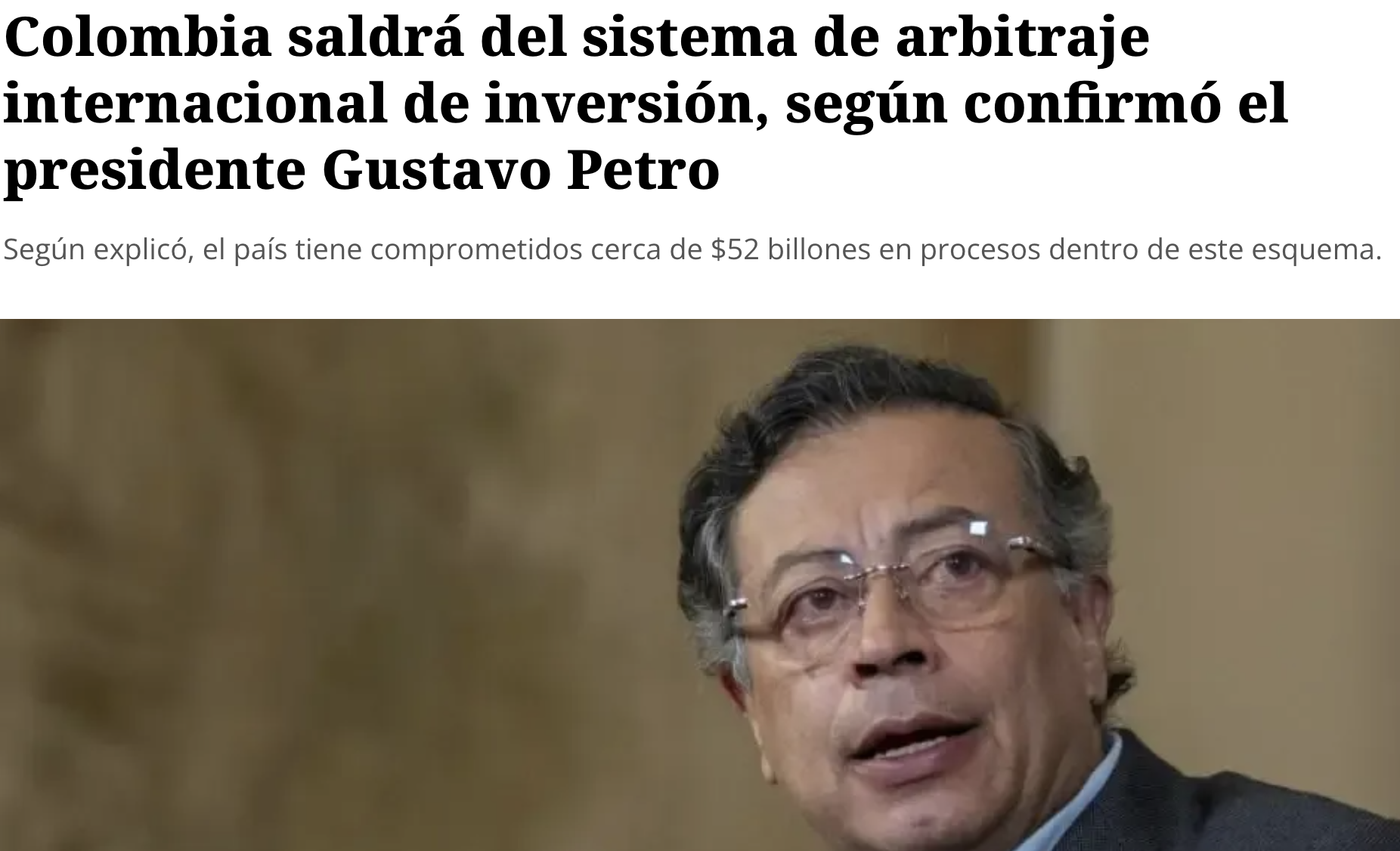
On March 23, 2026, a group of experts sent a letter to President Gustavo Petro, urging Colombia to withdraw from the investor-state dispute settlement (ISDS) system. The letter concerns the First International Conference on the Transition Beyond Fossil Fuels, to be held in Santa Marta, Colombia, from April 24 through 29, 2026. Two days later, President Petro announced that Colombia would withdraw from that system.
The arguments outlined in the letter address one of the most widely debated issues in the energy transition: the role of international investment law. As I argued in this article, there is growing concern that international investment protection may constrain governments’ ability to regulate the extractive industries as part of the energy transition policies. However, as discussed below, this risk—which is real—could be viewed from a broader perspective that allows for considering alternative approaches.
The Arguments in the Letter
The arguments in the letter to President Petro may be distilled into three principal points.
The first argument concerns a structural bias in the investment protection system. Specifically, the contention is that this system tends to favor foreign investors, particularly through large monetary awards against States. This critique parallels the position challenging international investment arbitration, arguing that it fails to uphold public values such as transparency.
The second argument holds that the dynamics of this system undermine regulatory powers in environmental protection, particularly the ability to curtail fossil fuel production. Indeed, one of the principal concerns in the energy transition context is that investment protection may produce the so-called regulatory chill effect—meaning that States, to avoid investor disputes, may refrain from enacting environmental regulatory measures.
Finally, the third argument is that this system confers a form of privilege upon foreign investors to the detriment of domestic investors. As I have explained in this article, this argument resonates widely throughout Latin America, particularly given the strong protections historically accorded to the principle of non-intervention.
In Search of Balance: The Position of the Inter-American Court
The arguments summarized in the letter point to criticisms that do indeed demonstrate the risks States face under the current ISDS system. Climate change adaptation and mitigation policies need regulatory flexibility, but the system may create constraints that reduce the policy space.
Yet addressing this risk does not necessarily require withdrawal from this system. While it is not possible to establish any direct causal relationship between investment protection and foreign direct investment flows, this system can contribute to the development of inclusive institutions that create the conditions necessary to attract capital investment. This observation is especially pertinent given Latin America’s strategic role in supplying critical minerals.
Indeed, decarbonization requires not only cutting back on fossil fuel use but also electrifying the economy. That process, among other factors, relies on critical minerals such as lithium. The production of these minerals, along with their supply chains, is essential for progress toward decarbonization.
The production of critical minerals requires capital investment, especially in capital-intensive activities such as direct lithium extraction. Such investments, in turn, depend on an institutional framework that affords effective protection to private property rights. The ISDS system could contribute to that objective.
In a similar vein, the Inter-American Court of Human Rights, in Advisory Opinion OC-32/25 of May 29, 2025, on the climate emergency, emphasized the importance of “promoting a balance that allows States to adopt legitimate regulatory measures in response to the climate crisis, without eroding the legal certainty and predictability that international investment agreements seek to guarantee as essential incentives for foreign direct investment.”
Protecting the Right to Regulate
The principal risk to climate change adaptation and mitigation policies does not arise directly from the system itself, but rather from its design—and specifically from the imprecise standards of protection found in the bilateral investment treaties (BITs) that Latin American countries concluded in the latter decades of the twentieth century. In particular, the “fair and equitable treatment standard” is inherently vague, broadening the scope of review over regulatory measures and thereby increasing the risk of interpretations that lead to regulatory chilling effects. This was precisely the root of Spain’s exposure to arbitral claims arising out of its renewable energy policies.
Latin American States, however, may reform their BITs to incorporate provisions protecting the right to regulate—that is, the sovereign power to design and enact economic policies, particularly those relating to environmental protection. As I argued in this article, this may be achieved through several reforms:
In the first place, the fair and equitable treatment standard may be replaced by more narrowly defined standards that protect investors solely against manifestly arbitrary measures. In this regard, as I have argued, comparative administrative law in Latin America incorporates principles oriented toward the prohibition of arbitrariness that may inform the interpretation of investor protection standards.
For example, the BIT between Ecuador and the United Arab Emirates (2025) narrowed this standard to grave violations such as denial of justice or manifestly arbitrary conduct.
In second place, treaties may provide that measures serving general public-interest objectives—such as those relating to environmental protection—shall be deemed consistent with the investors’ standards of protection, particularly with respect to indirect expropriation. For example, the BIT between China and Venezuela (2024) provides that non-discriminatory legal measures designed and applied to protect legitimate public welfare objectives, such as health, safety, and the environment, do not constitute indirect expropriation. The BIT between Venezuela and Colombia (2023) similarly provides that measures aimed at advancing the public-interest objectives defined in the treaty shall be deemed consistent with the standards of protection, provided they are not applied in an arbitrary or inequitable manner.
In third place, as illustrated by the treaty between Colombia and Spain (2021), protection of the right to regulate may be made explicit. Under that treaty, both States expressly recognized their “right to regulate” to enact reasonable measures aimed at achieving legitimate public policy objectives, including the protection of human rights, natural resources, and the environment.
Finally, and in fourth place, treaties may impose obligations upon investors. For example, the treatybetween Uruguay and Turkey (2022) provides that investors shall endeavor to incorporate internationally recognized corporate social responsibility standards into their internal practices and policies.
In this regard, the interpretation of the right to regulate—as has occasionally occurred in arbitral practice—should draw upon the general principles of administrative law to define the boundaries within which regulatory power may lawfully be exercised to advance climate change policies. These principles, well established in Latin American administrative law, may help strike the appropriate balance between climate policies and investor rights, while promoting convergence with the standards of protection applicable to domestic investors.
***
The risks posed by regulatory chill—which can constrain the flexibility of climate change adaptation and mitigation policies—stem primarily from the vagueness of investor protection standards. There are, to be sure, procedural deficiencies inherent in the organization of ad hoc arbitral tribunals under instruments such as the ICSID Convention, which are ill-suited to resolving public policy disputes. But the principal risk to be addressed remains the imprecision of these standards.
Withdrawing from the arbitration system removes that risk but also creates institutional conditions that may hinder the attraction of the capital investment needed to produce the critical minerals necessary for decarbonization efforts. When evaluating the advantages and disadvantages of the ISDS system, it is important to remember that climate change policies not only support reducing fossil fuel use but also promote the extraction of minerals essential for decarbonizing the economy. Therefore, the risks associated with fossil fuel policies should be weighed against the potential benefits that the ISDS system might offer regarding critical minerals.
An alternative approach to withdrawing from the ISDS system, as the Inter-American Court concluded, is to seek a balance between the right to regulate and investment protection—an endeavor that will require a new treaty model, tailored to the realities of Latin America.