On the recognition of the Government of Venezuela by the United States
/ 09-03-2026
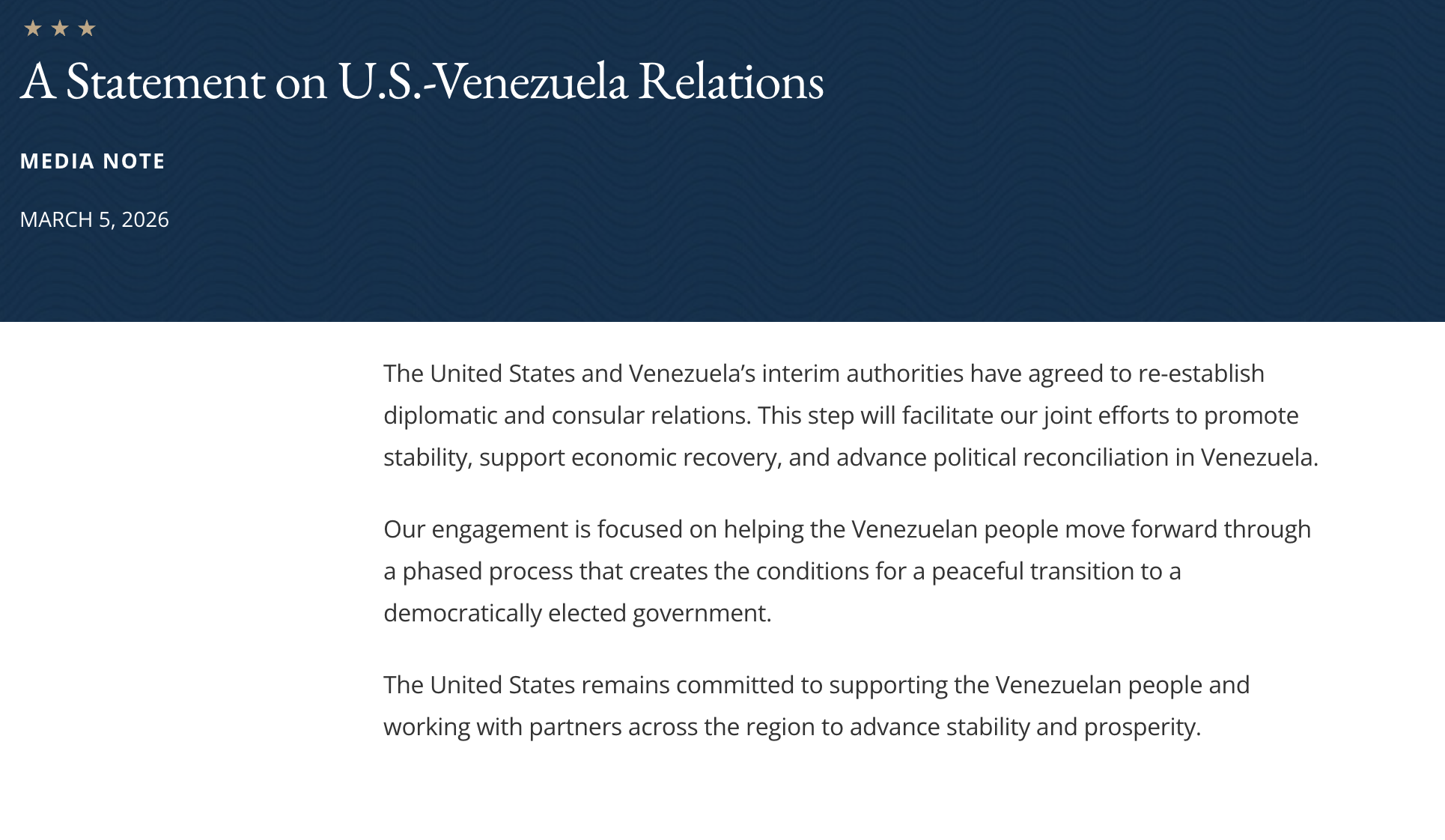
Fuente: State Department
We can recognize a man as an Emperor or as a Grocer. Recognition is meaningless without a defining formula
- On March 5, 2026, the State Department announced the reestablishment of diplomatic and consular relations with Venezuela’s “interim authorities”. This announcement raised questions about whether it implies formal recognition of those authorities as the “Government of Venezuela”. The doubt is greater when we consider President Trump’s repeated statements referring to Delcy Rodríguez as president. In particular, on March 7, while commenting on the resumption of diplomatic relations, President Trump pointed out that the “interim authorities” had been legally recognized.
- In this scenario, the question arises: which Venezuelan government is the “Government of Venezuela” recognized by the United States?
- The recognition of governments, as Winston Churchill warned, is meaningless without a practical formula. From a strict international law perspective, the states -not governments- are the subject of recognition. However, in some cases, it may be necessary to establish which polity has the legal authority to represent a foreign state. “Recognition of governments” specifically refers to this legal decision capability.
- In U.S. constitutional law, as concluded, among others, in the case Underhill v. Hernandez (168 U.S. 250 (1897), the Presidency has the exclusive prerogative to recognize governments as the legal representatives of foreign states, as part of the presidential authority in foreign relations. In normal conditions, the decision is a practical one, based on the factual engagement with the representative of the foreign country, for instance, after an election.
- But Venezuela is not a normal case. On January 23, 2019, President Trump recognized the speaker of the 2015 National Assembly as the president. This decision had a specific legal consequence: the Government of Venezuela’s representation shifted from Maduro to the speaker. Hence, the State Department certified the speaker as the exclusive authority of Venezuela, under Section 25B of the Federal Reserve Act.
- In 2023, the interim Presidency was suppressed, and the legal representation shifted to the 2015 National Assembly. In a statement of opinion filed in 2025, the Trump administration stated that Maduro was not the legally recognized president and that only the 2015 National Assembly could represent the Government of Venezuela.
- Those specific legal consequences had not yet changed, despite frequent interactions with the “interim authorities”. The reestablishment of diplomatic and consultative relations does not imply the legal capacity to represent the Government of Venezuela. One lesson from the United Kingdom‘s legal recognition of the interim president is that diplomatic relations and legal representation can be separated. Also, the frequent interactions between the Trump administration and the “interim authorities” do not imply formal or de jure recognition. It is not relevant, either, that Delcy Rodríguez is acknowledged as “president”.
- What really matters are the practical implications of the legal representation. At least for now, it seems that the 2015 National Assembly still retains that legal representation. For the situation to change, more than just a political declaration is required. What is needed are legally binding decisions that transfer legal representation from the National Assembly to “interim authorities”, such as through a new certification under Section 25B
- Those decisions could be adopted in a court. For instance, in one of the cases against Venezuela pending before the federal courts, the U.S. Government should clarify in the next few days whether the 2015 National Assembly or the “interim authorities” are considered the legal representatives of the Government of Venezuela. If the Department of Justice, based on the State’s guidance, declares that the recognized government is the “interim authorities”, then the legal representation will shift.
- If a formal decision is adopted with a practical formula for recognition, the legal representation of the Government of Venezuela will be transferred to the “interim authorities”. There will be many legal implications of that change.’
- One of the main consequences is that the “interim authorities” will have the legal capacity to represent the Government of Venezuela as the owner of assets and properties in the U.S. The most relevant asset in Citgo. Hence, the board of PDVSA, under the “interim authorities”, will be able to exercise its shareholder rights to appoint new directors to PDV Holding, Inc., thereby regaining control of Citgo.
- Also, the interim authorities will be able to represent the Republic of Venezuela and the Central Bank in the Federal Reserve Banks. However, under Executive Order 14373, neither PDVSA nor the Central Bank controls oil, gas, and gold revenues, as part of the regulatory sanitation room created by the Trump administration. Regaining legal representation will not imply regaining access to core fiscal incomes.
- Formal or de jure recognition will not unblock any assets. Instead, all Government of Venezuela assets in the U.S. will remain blocked under the economic sanctions regulations. Consequently, even “interim authorities” would need OFAC licenses to use these assets.
- Along with the assets, the interim authorities would assume the legal obligations related to liabilities, especially the claims stemming from Venezuela’s $170 billion external debt, including numerous pending cases in the U.S courts. Importantly, those authorities would represent PDVSA in the auction sale process of the shares of PDV Holding, Inc., pending before the Delaware District Court.
- Finally, it should be clarified that any formal recognition will have consequences only in the U.S. If the U.S. Government acknowledges Delcy Rodríguez as the president of Venezuela, that will not imply that she is the lawful president under Venezuelan constitutional law. The situation will be paradoxical because Rodríguez has sidestepped serving as acting president under the Venezuelan Constitution to avoid declaring a presidential vacancy and calling for an election. Hence, according to this interpretation, Nicolás Maduro is still the lawful president. Due to formal recognition, Rodriguez might finally assume the role of acting president under Articles 233 and 234 of the Constitution, triggering the electoral process.