Why Are International Oil Companies Reluctant to Enter Venezuela?
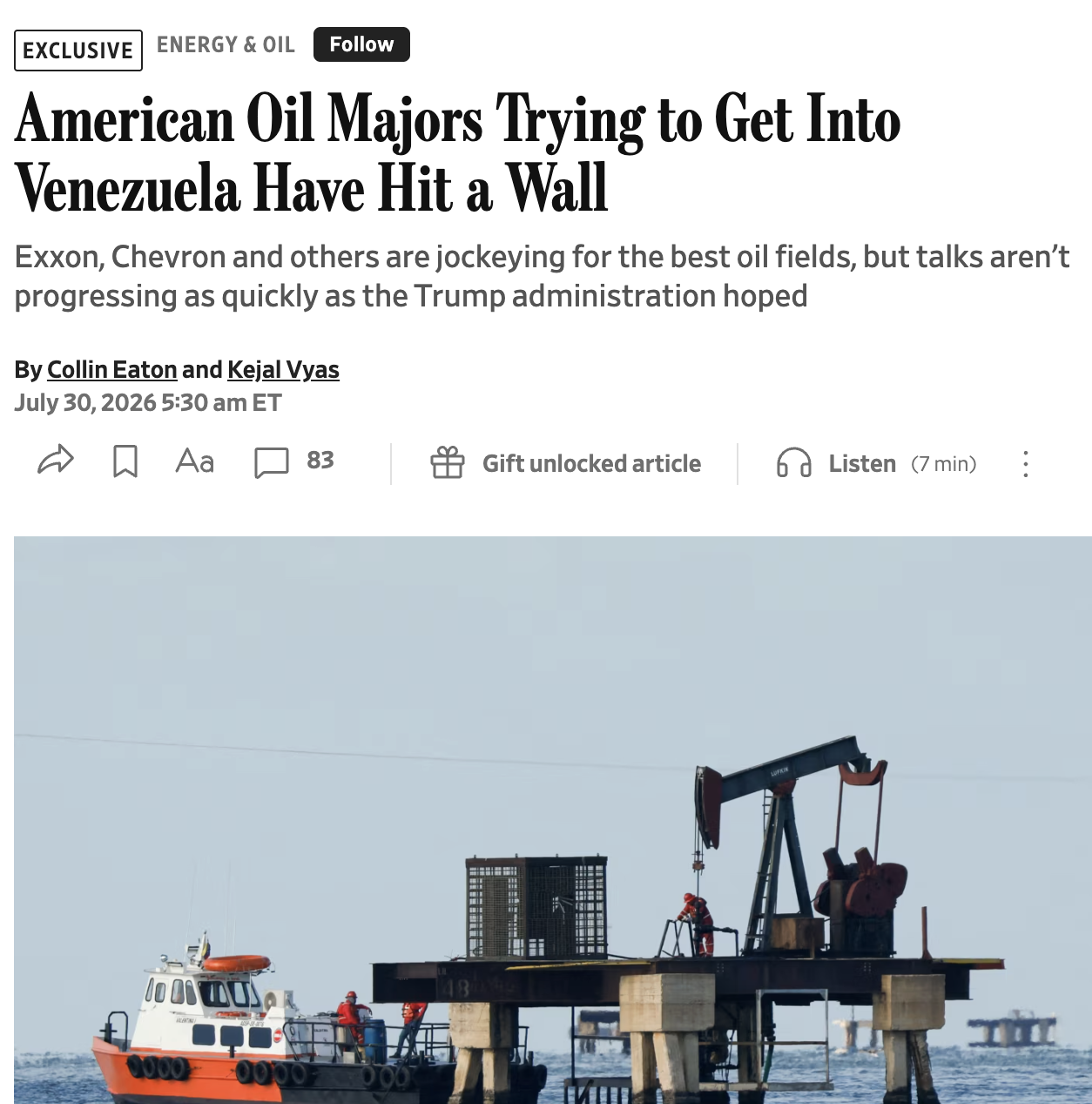
A recent report by the Wall Street Journal explained that “seven months after the U.S. deposed strongman Nicolás Maduro, Big Oil has yet to make any big moves in Venezuela”. The report included my remarks on the topic: “It’s like when you’re trying to sell your house,” I explained. “You have a very successful open house with 100 people attending, but then nobody calls.”
The reluctance is not a surprise, though. Since January 3, 2026, the oil regulation has undergone a dramatic and positive change. The specific reforms of the Organic Hydrocarbons Law authorized private investors to engage in oil activities, subject to production-sharing agreements signed with PDVSA affiliates and joint ventures. The real change was not the recognition of oil contracts with private investors, since that institution had already been implemented in 2018. What changed was the institutional framework.
The old oil contracts, known as productive participation contracts (CPP), were based on a highly questionable framework derived from the so-called Anti-Blockade Law, a legal instrument adopted by the now-defunct 2017 national constituent assembly that, in effect, disavowed the protection of economic rights. Now, the new contracts have legal foundations that provide enhanced protections for private investments.
The key takeaway is that institutions are crucial. Ramon Espinasa and Lenin Balza highlighted how the institutional framework affects the oil sector’s performance. The Anti-Blockade Law, in that sense, created two opposite effects. On the one hand, it supported the CPP model, which allowed private investors to undertake oil activities that PDVSA was unable to perform; on the other hand, it impaired investor protection and concentrated unconstrained regulatory powers. In balance, the CPP model, together with the U.S. government’s supportive licensing policies, favored a modest increase in production. However, to progress further, it was essential to surpass the Anti-Blockade Law, just as the January reforms did.
From this institutional perspective, the main advantage of the legislative reforms was that they raised the institutional quality of the contracts without disturbing their commercial architecture. The same CPP can now be executed on broadly similar terms, but on firmer legal foundations. What changed was not the scope of the contractual rights but the strength of the institutions that back them.
Even so, the change is not enough to lift production above the 1,200-barrel-per-day (tbpd) threshold defined by the U.S. government. To do so, it is necessary to achieve three key objectives: (i) recognizing stable and clear contractual rights, particularly regarding the marketing of the oil produced; (ii) defining an attractive “government take”; and (iii) enhancing contract enforcement.
The U.S. government adopted the right policies to advance those objectives, including General License 52A (GL 52A), which provides open authorization to sign oil contracts with PDVSA’s affiliates and joint ventures. However, the institutional framework in Venezuela did not evolve favorably.
First, the “government take,” which should have been defined in February, was not regulated until July 7, and even then with some loopholes. As a result, only since July 7 — once the implementing regulation was in place — have new investors been able to advance negotiations for new oil contracts.
Second, the regulations approved on July 7 concentrate regulatory power in the oil ministry, increasing the regulatory burden and reducing the legal certainty of private investors’ rights.
Finally, the reorganization of the oil contracts should have been completed on July 28, yet significant uncertainty remains regarding how they will be treated, and the general conditions of the new contracts still have to be defined.
When we consider these three causes together, it is unsurprising that international oil companies are still weighing whether to move forward, notwithstanding the favorable conditions created by U.S. policies, reaffirmed by the hydrocarbons reform, and the current price windfall. The gap, in other words, is institutional — which is precisely why it is fixable, and why these assets remain worth pursuing once the right conditions are in place.
To turn expressions of interest into the capital expenditure Venezuela actually needs, three institutional reforms should be advanced within the scope the hydrocarbons reform allows:
First, the terms of the “government take” should be clarified and, ideally, anchored in legislation, so that investors can rely on their stability across the life of a project.
Second, a regulatory-improvement agenda should reduce the burden created by concentrating regulatory power within the oil ministry by delegating technical functions to a specialized agency operating under transparent, rules-based criteria.
Finally, the contract model should set out specific, clear, and stable rights that enable private investors to conduct the full range of activities, from exploration to marketing. To improve contractual governance, PDVSA could establish a new affiliate that functions as a technical agency to oversee new contracts, adhering to general standards of transparency and accountability. To that end, it is also necessary to advance comprehensive economic legislative reforms to introduce pro-market institutions and abolish instruments such as the Anti-Blockade Law.
Taken together, these reforms would materially strengthen the sector’s institutional framework and supply some of the incentives needed to attract private investment at scale.
Beyond institutional reform, rebuilding the capacity of a fragile Venezuelan state will be essential — above all to restore reliable electricity supply and other infrastructure, including assets damaged by the June 24 earthquake.
In short, the reform begun in January should be completed. But even with this objective achieved, it is necessary to recognize that the reform of the Organic Hydrocarbons Law is clearly insufficient to advance a comprehensive redesign of the oil industry and to create the institutional conditions to reach and surpass the 3,000 tbpd threshold.
To durably raise output, Venezuela will ultimately need broader legislation to liberalize the industry and move beyond the petro-state model, under inclusive and stable democratic institutions.
Until the political conditions evolve to allow Venezuela to move in that direction, it is possible to improve the regulatory quality of the specific reforms introduced in January and to lay the foundation for a new oil sector driven by private investors.